Drain rodding can be a suitable choice when a blockage is reachable from an appropriate access point and can be mechanically disturbed or removed without cleaning a longer pipe section. Jetting may be more appropriate where deposits need to be washed from an extended run, subject to the pipe’s condition and the material present. Neither method is automatically better for every blockage.
The decision should start with the suspected restriction, pipe route and available access. Asking for a particular method solely because it worked at another property can result in an unsuitable scope of work. The aim is to restore drainage while identifying what further investigation, if any, is needed.
What does drain rodding actually do?
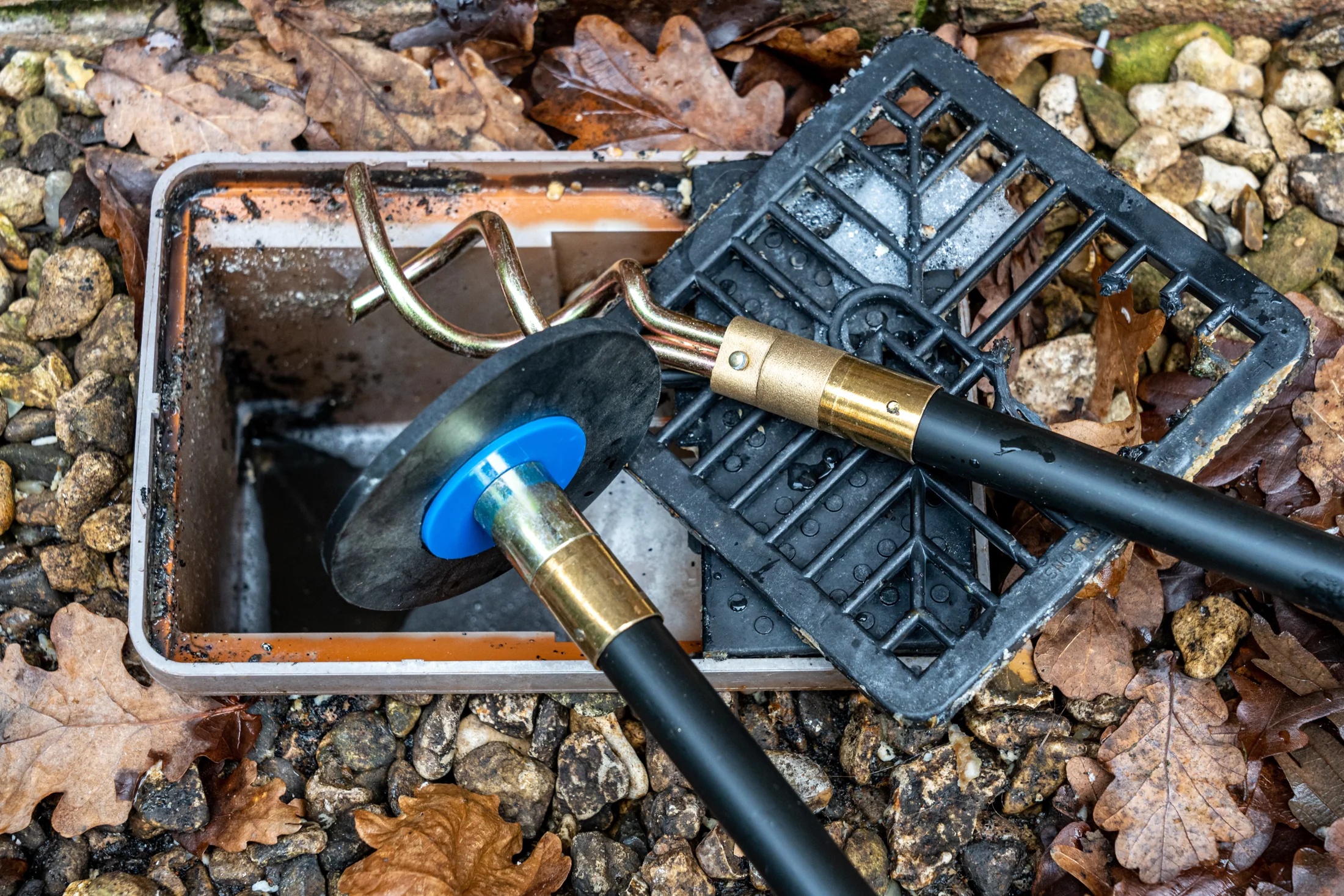
Drain rodding uses connected flexible or semi-rigid rods introduced through a suitable drainage access point. Different ends can be used to disturb or retrieve material, depending on the type of obstruction and pipework involved. The mechanical action is concentrated around the point reached by the rods.
That makes rodding different from using a water jet to mobilise deposits along pipe walls. A successful rodding intervention may restore a passage through a blockage without removing every deposit elsewhere in the connected drain.
A rodding eye, inspection chamber or other suitable fitting may provide access. England’s Approved Document H addresses access for clearing drain blockages, including rodding eyes, access fittings, inspection chambers and manholes. Access position, bends and junctions affect which run can be reached.
A visible chamber does not establish that rods can reach every branch connected to it. The direction of approach and the actual arrangement must be considered.
When does rodding make practical sense?
Rodding may be considered where an accessible drain run contains a relatively local obstruction that responds to mechanical disturbance. For example, a section restricted by compacted ordinary debris may be accessible through an existing rodding point or chamber.
Before selecting the method, the contractor needs to consider:
- The location of the suspected restriction relative to the available access point.
- The likely nature of the obstruction and any material previously recovered.
- Pipe diameter, bends, junctions and any known changes in size.
- Whether earlier inspections identified displaced joints, fractures or other defects.
- Whether the intention is to open a local obstruction or clean deposits from a longer section.
If the available information does not establish the restriction’s position, it may be more useful to investigate the route than to insist on rods as the first or only technique.
When might jetting be the better option?
Jetting uses pressurised water delivered through a hose and nozzle to act on material in the drain. It can be considered when the obstruction or deposit pattern requires a different form of removal from mechanical rodding.
Deposits distributed along a run present a different maintenance objective from a single local obstruction. Where a pipe has accumulated material across a substantial length, simply making an opening through one restriction may not restore the available passage throughout the affected section.
However, jetting cannot be assumed suitable solely because it is a powered method. Pipe condition, connected branches, the type of material and the destination of displaced solids all influence the proposed work.
For more information about removing deposits with pressurised water, see our drain jetting service.
What if the blockage is caused by a pipe defect?
Neither rodding nor jetting repairs a collapsed pipe, significantly displaced connection or structural defect. Clearance may remove material caught at a defect and temporarily improve flow, but the cause of repeated obstruction can remain.
Similarly, finding roots or debris does not establish the full condition of the pipe. Material may enter or accumulate at one point and become lodged elsewhere. The location where flow is restored is not necessarily the point where material first entered the system.
If earlier work identified a damaged section, the next decision should reflect that finding. Repeatedly applying greater mechanical force or changing clearance methods without examining the underlying condition may fail to answer why the obstruction keeps returning.
How important is access when choosing between methods?
Access can determine whether a technically plausible method is practical for a particular drain. A short run with a suitable rodding eye presents different conditions from an extended underground route reached through several chambers.
The Government’s drainage guidance for England recognises that clearing blockages requires suitable access positioned according to the layout, depth and size of the drain. Bends, changes in gradient, junctions and pipe-size changes are relevant to where access is provided.
For existing drainage, drawings may not reflect later alterations. A contractor may need to establish the actual route before deciding whether a chosen access point reaches the affected section.
Where a property has several inspection chambers, identifying the chamber nearest the visible symptom is not enough. The affected branch may connect farther downstream, or a chamber that appears close on the ground may serve a different run.
What should a customer ask before agreeing to the method?
The most useful questions are about the proposed result rather than simply comparing equipment names:
- Which drain section is believed to be restricted? Ask what observations support that location.
- Where will access be obtained? Establish whether the proposed point actually serves the affected run.
- Why is rodding or jetting appropriate? The answer should relate to the obstruction, pipe condition and required outcome.
- What will happen if the method restores only partial flow? Clarify whether further clearance or investigation would be considered separately.
- How will success be assessed? The check should relate to the facilities or drainage section that originally failed.
If the obstruction recurs, keep a record of the earlier clearance method and what was found. Our guide to what causes blocked drains explains how accumulated material and pipe defects can contribute to repeat problems.
When should you request professional drain rodding?
Request a rodding assessment when the problem appears to involve an accessible drain run with a local obstruction, while leaving the final choice of method dependent on the actual pipe and blockage. Describe any previous clearance, whether several outlets are affected and which drainage access points are known.
A useful completion record identifies the section treated, the material observed if identifiable, the method used and the outcome. Restoring flow should not be presented as confirmation that an uninspected pipe is free of defects.
For an obstruction that may be suitable for mechanical clearance, request a quote for professional drain rodding with the blockage symptoms and available access details.